by
by Most Formula 1 races are over before the last lap.
The strategy played out, the gaps held, and the faster car won. Scroll to the results, check the standings, and move on.
The races on this list are the exceptions.
These are the finishes where the last lap rewrote everything that came before it, championships snatched away, legends made under pressure, drivers doing things that shouldn’t have been possible given the circumstances.
The greatest last-lap victories in Formula 1 don’t just end races. They tend to define careers.
Greatest Last-Lap Victories in Formula 1 History
Here are ten of them, ranked.
The 10 Greatest Last-Lap Victories in Formula 1, Ranked
10. Spanish GP, 1986 — A Photo Finish 70 Years in the Making
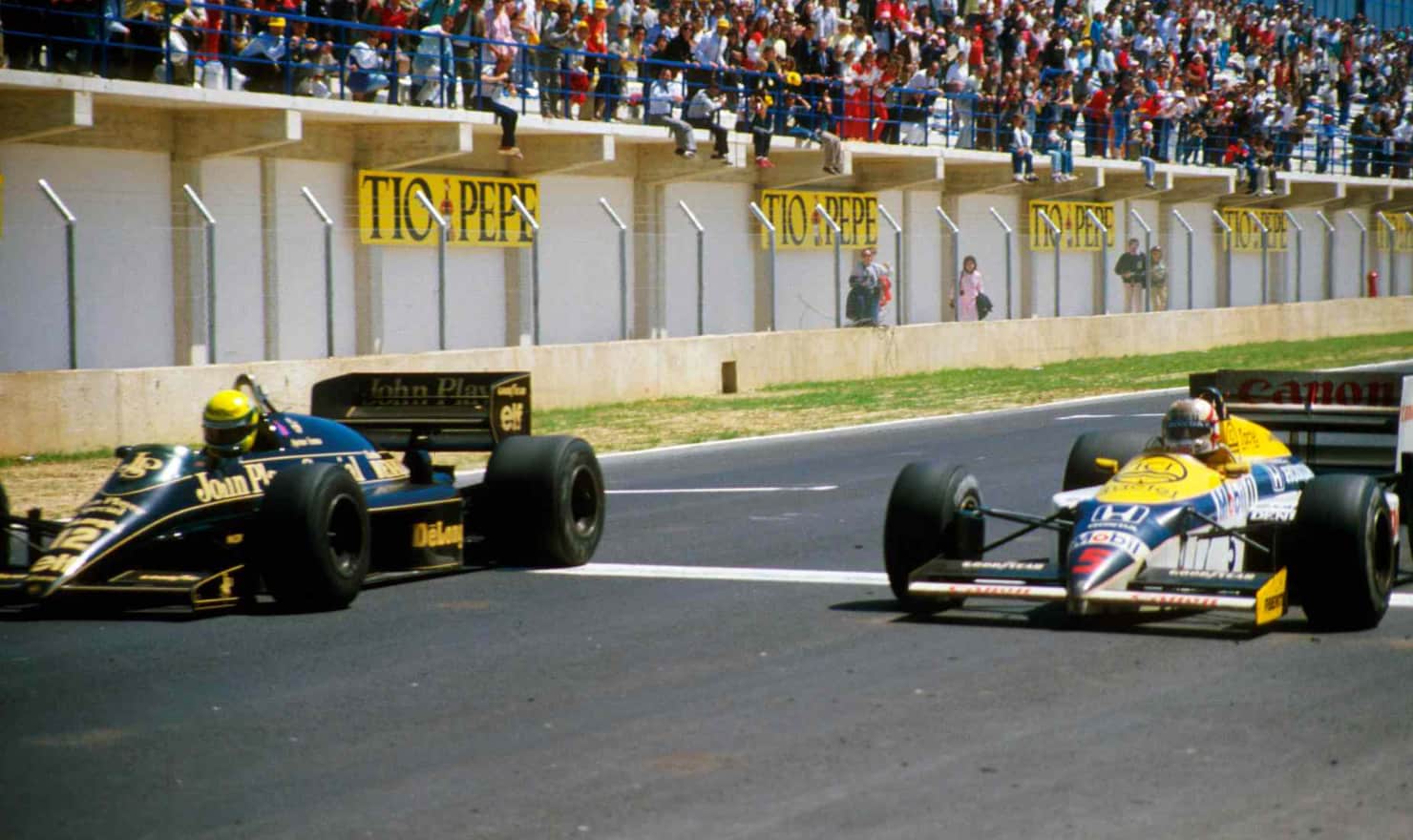
Ayrton Senna and Nigel Mansell spent the final lap of the 1986 Spanish Grand Prix running wheel-to-wheel. The gap at the checkered flag: 0.014 seconds. At that speed, it’s the length of a car bonnet. Senna held the inside and that was enough. It remains one of the most replayed finishes in the sport’s archive.
9. Hungarian GP, 2014 — Ricciardo Hunts Down Two Champions
The Hungaroring is not an easy place to overtake. Daniel Ricciardo did it twice in the closing laps anyway—first past Hamilton, then past Alonso, both on fresher tires, both executed without drama. The kind of win that looks clean in hindsight but required Ricciardo to make two correct decisions under pressure, with nowhere to make a mistake.
8. Belgian GP, 2000 — The Move That Still Gets Replayed
On the Kemmel Straight at Spa, Mika Häkkinen pulled off what commentators at the time struggled to describe, and analysts have been explaining ever since. Using a backmarker as a natural dividing line, he split the road in two and went around the outside of Michael Schumacher in one movement. The move worked because Schumacher had no room to respond and no time to anticipate it. Twenty-five years later, it’s still the answer when people ask what the best overtake in F1 history looks like.
7. Monaco GP, 1992 — Senna Turns Defense Into Art
On a circuit where overtaking is essentially theoretical, Nigel Mansell closed five seconds in a handful of laps on fresh tires and arrived in Senna’s mirrors with time left to race. Senna gave him nothing. Every braking point covered, every apex claimed, every potential gap closed before it opened. Two seconds at the flag, but Mansell never had a real chance from the moment Senna decided he wasn’t going to lose. A defensive drive with no equal at Monaco before or since.
6. San Marino GP, 2005 — Alonso Wins With His Head, Not His Throttle
Imola rewarded patience in 2005. Schumacher’s Ferrari had the pace in the closing stages; Alonso’s Renault had the position. Alonso drove the gap, not the lap time—tracking Schumacher’s lines, covering the obvious attack points, controlling the space rather than the speed. He crossed the line first. It was the moment many observers stopped thinking of Alonso as a promising young talent and started thinking of him as someone Schumacher would have to worry about for years.
5. Canadian GP, 2011 — Button’s Race That Refused to End
The 2011 Canadian Grand Prix lasted four hours and four minutes the longest race in modern F1 history at the time. Jenson Button accumulated six pit stops and a drive-through penalty and still won. The final lap was the culmination of everything: Button on fresher rubber, Vettel under pressure, and a moment at the hairpin where Vettel went wide, and Button went through. If the race had been five laps shorter, none of it would have mattered. It wasn’t five laps shorter.
4. Japanese GP, 1989 — The Championship Decided by Contact
Senna needed to beat Prost at Suzuka to stay alive in the title race. They collided at the chicane. Senna continued, won, and was disqualified for rejoining the track illegally. Prost was champion. Whether the original contact was intentional, accidental, or somewhere in between is a question that generates the same circular arguments it always has. What’s not disputed: the result ended one of the most intense driver rivalries the sport has seen, and it ended messily.
3. Austrian GP, 2002 — A Victory Nobody Celebrated
Rubens Barrichello was faster. He led. Ferrari called him on the radio in the final meters and told him to move over. He did. Schumacher crossed the line first. The trophy presentation was awkward. The crowd made clear what they thought. The FIA brought in explicit team order rules the following year, later softened, later removed entirely—a regulatory journey that started in the Austrian paddock in 2002. This entry is here because it changed the sport’s rulebook, not because it was good racing.
2. Abu Dhabi GP, 2021 — The Lap That Ended a Season and Started an Argument
Late safety car. Disputed restart procedure. Verstappen on fresh mediums, Hamilton on thirty-lap-old hards, one lap to go. Verstappen passed Hamilton at Turn 5 and held it to the flag. His first world championship. The FIA’s subsequent investigation found that race director Michael Masi had not applied the correct procedure when clearing lapped cars. Masi was replaced before the following season. The conversation about what should have happened has not stopped since. As a piece of pure last-lap racing, though—one driver on better tires hunting down a champion under maximum pressure—it belongs near the top of any list.
1. Brazilian GP, 2008 — Five Seconds That Rewrote the Season
Felipe Massa crossed the line at Interlagos in 2008 as Formula 1 world champion. For approximately five seconds, that was true.
Then Lewis Hamilton, who needed fifth place to take the title and had been running sixth, passed Timo Glock at the final corner.
Glock was on dry-weather tires in damp conditions and had no pace left. Hamilton went through. Fifth place. Champion.
The garage celebrations from Ferrari, already underway, stopped. Hamilton’s team erupted. Massa had to be told what had happened.
The youngest world champion in F1 history at the time, he decided at Turn 12, Lap 71, with about eight seconds left on the clock.
No other moment on this list comes close to timing. Or cruelty, depending on which side you were on.
Why Last-Lap Finishes Hit Differently?
Tire strategy closes gaps. Safety cars compress fields. Rain degrades rubber at different rates for different cars.
All of these things are features of Formula 1 that make last-lap drama structurally more likely than in most motorsports.
But the races on this list aren’t just products of circumstance.
Each one required a driver to make a correct decision, an overtake, a defensive move, a tire gamble at the exact moment it mattered most, with no room for error and no second attempt.
That’s what separates an intense last-lap battle in F1 history from an ordinary late-race pass.
The stakes have to be high enough that the wrong decision is permanent.
FAQs
- What is the most dramatic last-lap victory in Formula 1 history?
The 2008 Brazilian Grand Prix. Lewis Hamilton passed Timo Glock at the final corner of the final lap to take fifth place and the championship by one point, completing a reversal that took roughly five seconds after Massa had already been announced champion in the Ferrari garage.
- Which F1 driver has the best record in last-lap battles?
Ayrton Senna and Lewis Hamilton appear most frequently in discussions of the best late-race racers. Senna’s Monaco defense in 1992 and Hamilton’s 2008 title pass are the clearest examples. Max Verstappen’s 2021 Abu Dhabi lap belongs in the same conversation.
- Why do so many F1 championships come down to the final race?
The points system is designed to keep championships competitive deep into the season. Combined with tire strategy and safety car timing, making late-race position changes common, it creates conditions where a season-long gap can disappear in the final laps of the final round.
- What was the dispute in the 2021 Abu Dhabi Grand Prix?
Race director Michael Masi allowed only some lapped cars to unlap themselves before the final safety car restart, placing Verstappen directly behind Hamilton with one lap left. The FIA’s review found this didn’t follow the correct procedure. Masi left his position before the 2022 season.
- Has an F1 race ever been decided by a pass at the very last corner?
Yes. The 2008 Brazilian Grand Prix was decided when Hamilton passed Glock at the final corner of the final lap, taking the fifth place he needed for the championship. It’s the most extreme example in the sport’s modern era.
Conclusion:
The greatest last-lap victories in Formula 1 have one thing in common: the result wasn’t obvious until it was over.
Hamilton at Interlagos. Häkkinen at Spa. Button at Montreal.
Each finish was the product of something specific: a tire compound choice, a gap left open for a fraction too long, a moment of pressure that cracked the driver under it.
Formula 1 teams spend entire seasons trying to eliminate uncertainty.
These ten races are what uncertainty looks like when it survives to the final lap.